

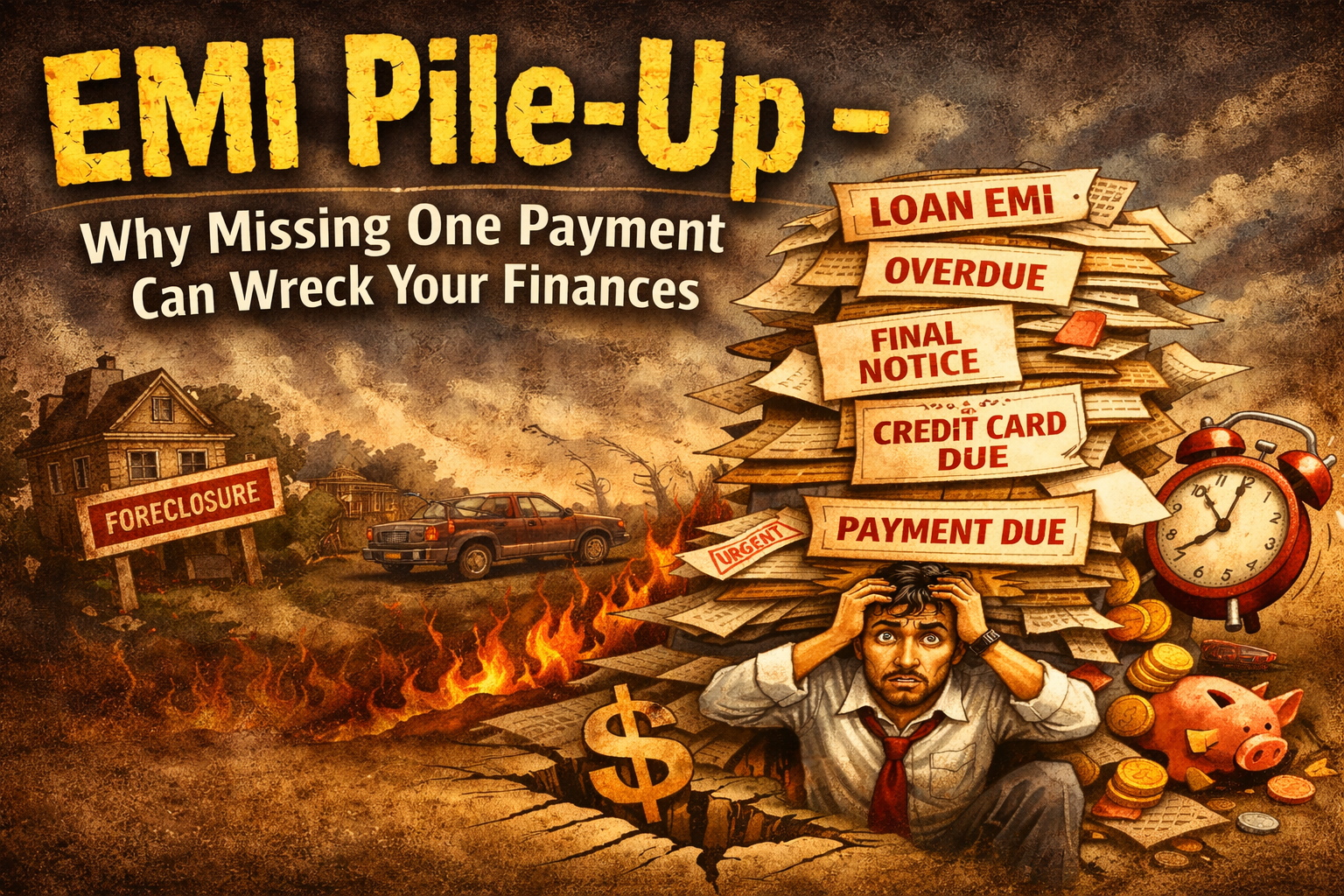
In today’s fast-paced financial world, Equated Monthly Installments (EMIs) have become a normal part of life. Home loans, personal loans, credit cards, car loans—almost everything runs on EMIs. But what many borrowers don’t realize is that missing just one EMI can start a dangerous financial domino effect, commonly known as EMI pile-up.
This article explains what EMI pile-up is, how it begins, why it becomes so destructive, and what you can do—before the situation goes out of control.
What Is EMI Pile-Up?
EMI pile-up happens when a borrower misses one EMI and is unable to catch up in the following months. The unpaid EMI doesn’t disappear—instead, it adds up with penalties, interest, and late fees, making the next month’s financial burden even heavier.
Very quickly, one missed payment turns into:
- Two overdue EMIs
- Accumulated late charges
- Higher interest
- Constant recovery calls
And before you know it, your finances are under serious stress.
How Missing One EMI Starts the Chain Reaction
Here’s how the problem usually begins:
1. Late Payment Charges & Penal Interest
The moment you miss an EMI, banks and NBFCs start adding penal interest and late fees. Your outstanding amount increases instantly.
2. Next EMI Becomes Harder to Pay
Now you’re not paying just one EMI—you’re paying:
-
Current EMI
-
Previous unpaid EMI
-
Penalties + interest
This makes the next payment far more difficult.
3. Continuous Defaults Begin
If income is tight, borrowers often skip another EMI to manage household expenses. This is where EMI pile-up officially starts.
How EMI Pile-Up Wrecks Your Finances
❌ Severe Impact on CIBIL Score
Even a single missed EMI can drop your CIBIL score by 50–100 points. Multiple missed payments can completely destroy your credit profile, making future loans almost impossible.
Recovery Calls & Mental Stress
Once EMIs remain unpaid, recovery agents start calling—sometimes multiple times a day. The stress affects:
-
Mental health
-
Family life
-
Work performance
Legal Notices & Loan Recall
If defaults continue, lenders may:
-
Send legal notices
-
Recall the full loan amount
-
File recovery cases
Asset Seizure Risk
For secured loans like home or car loans, continued EMI pile-up can lead to property or vehicle repossession.
Why Borrowers Fail to Recover After One Missed EMI
Most borrowers believe:
“I’ll clear it next month.”
But the reality is different because:
- Penalties keep increasing
- Monthly obligations grow
- Income remains the same
- New loans become unavailable due to low CIBIL score
This financial trap becomes harder to escape with every passing month.
Early Warning Signs of EMI Pile-Up
If you notice any of these, take action immediately:
- Paying EMIs using credit cards or borrowings
- Skipping EMIs to manage daily expenses
- Ignoring bank calls or messages
- Receiving repeated overdue reminders
What To Do If EMI Pile-Up Has Already Started
Talk to the Lender Immediately
Banks are more flexible before the loan turns into an NPA. You may get:
- EMI restructuring
- Temporary moratorium
- Reduced EMI for a short period
Consider Loan Settlement (If Situation Is Severe)
If you are already in default and unable to repay the full loan, loan settlement or One-Time Settlement (OTS) can be a legal way out.
Loan settlement allows borrowers to:
- Close the loan by paying a negotiated amount
- Stop recovery harassment
- Avoid long legal battles
Loan settlement should always be done legally and strategically, as it affects your credit score.
How to Prevent EMI Pile-Up in the Future
- Maintain an emergency fund (at least 3–6 months of EMIs)
- Never over-leverage with multiple loans
- Track EMIs with auto-debit alerts
- Act fast at the first missed payment
Final Thoughts
EMI pile-up doesn’t start with financial irresponsibility—it starts with one bad month.
But ignoring that one missed EMI can snowball into serious financial damage.
If you’re already struggling, early action is the key. Whether it’s restructuring, negotiation, or loan settlement, addressing the issue at the right time can save your finances, your credit score, and your peace of mind.
Follow Us:

